
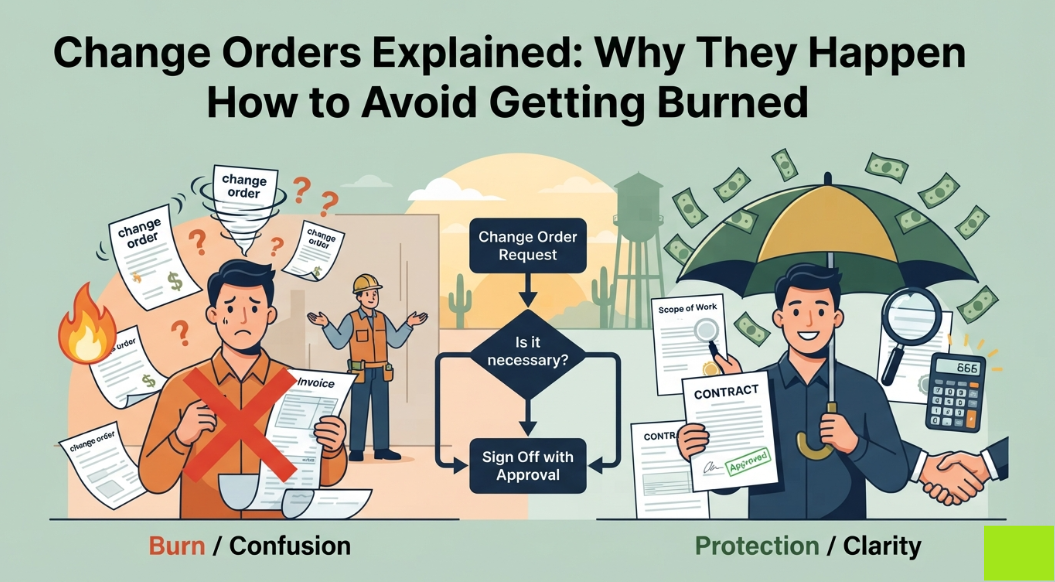
Change Orders Explained: Why They Happen and How to Avoid Getting Burned
A change order is a written, agreed modification to your original remodeling contract — a change in scope, materials, or price, documented and signed by both parties before the new work proceeds. That’s the whole concept, and on paper it’s completely reasonable. In practice, “change orders” are also the mechanism behind one of the most common bathroom remodel horror stories homeowners share online: a suspiciously low initial bid that balloons once work is already underway and walking away isn’t a realistic option anymore. Understanding the real difference between a legitimate change order and a predatory one is one of the most protective things you can know before you sign a remodeling contract.
What a Change Order Actually Is
A change order modifies your original signed agreement — typically adjusting price, timeline, or scope — and should always be documented in writing with both parties’ sign-off before the associated work begins. A verbal “yeah, that’ll be a bit more” is not a change order; it’s exactly the kind of undocumented scope creep that leads to disputes over what was actually agreed to.
Legitimate Reasons Change Orders Happen
Hidden Conditions Found During Demolition
As covered in detail on our What We Find in Older Gilbert Bathrooms page, genuinely common findings in Gilbert’s older housing stock — a failing waterproofing membrane, outdated plumbing, water-damaged subfloor — are things no contractor can see or price accurately before demolition opens the wall. A change order addressing a real, previously invisible condition is legitimate, provided it’s explained clearly, priced fairly, and agreed to before the additional work proceeds.
You Change Your Mind Mid-Project
If you decide partway through to upgrade a tile selection, add a feature that wasn’t in the original design, or change a fixture, that’s a legitimate scope change you’re initiating, and it should be priced and documented the same way.
Code Requirements Discovered Along the Way
Occasionally, an inspector identifies a code requirement that wasn’t apparent during initial planning — this is uncommon with a properly designed and permitted project, but it does happen, and addressing it is a legitimate, necessary change rather than an optional upsell.
The Pattern Behind Predatory Change Orders
An Unrealistically Low Initial Bid
If one bid comes in noticeably lower than every other bid you’ve collected for comparable scope, that’s sometimes a legitimate efficiency advantage — and sometimes a deliberate strategy to win the job cheap, then recover the real cost (and more) through change orders once you’re already committed and less likely to switch contractors mid-project.
Vague Original Contracts
A contract with vague material “allowances” instead of specific selections, or scope language open to interpretation, creates exactly the ambiguity a bad-faith contractor uses to justify “that wasn’t included” once work is underway. Full detail on our How to Avoid a Bad Contractor Experience page.
Change Orders Presented as Non-Negotiable Facts, Not Discussions
A legitimate change order comes with an explanation and a real conversation about options. A predatory one is often presented as “this is just what it costs now,” with pressure to agree quickly since work has already started and stopping feels disruptive.
No Original Documentation to Compare Against
If your original contract wasn’t detailed and itemized to begin with, it’s genuinely hard to prove what was or wasn’t included when a dispute arises — which is exactly why a vague original scope is a red flag long before any change order ever comes up.
How to Protect Yourself Before You Ever Sign
Start With a Genuinely Detailed, Itemized Contract
The single best protection against change-order abuse happens before the project starts: a fixed, itemized proposal with specific material selections, not vague allowances, gives you a clear document to hold any later change against.
Ask Directly How Change Orders Are Handled
During your initial consultation, ask specifically: how are unexpected findings communicated, priced, and approved? A contractor with a clear, confident answer has done this professionally before. Vague or dismissive answers are worth taking seriously as a warning sign.
Require Written Approval Before Any Additional Work Begins
Never allow additional work to proceed based on a verbal conversation alone. A legitimate change order is documented and signed before the crew moves forward with it, not billed after the fact as a surprise.
Build a Contingency Into Your Budget From the Start
As covered on our How to Budget for a Bathroom Remodel page, planning a realistic 10 to 15 percent contingency for an older home means a legitimate, well-documented change order doesn’t derail your finances — it’s already part of the plan.
How Ironwood Handles Change Orders
- Every project starts with a fixed, itemized proposal, not a vague estimate with room for interpretation later
- If demolition reveals a genuine hidden issue, we show it to you directly and explain the real options
- Any additional work is priced and documented in writing, with your approval, before it proceeds
- We never bill additional work as a surprise on a final invoice
If a change comes up on your project, this is the process — no exceptions, and nothing added without your sign-off first.
Frequently Asked Questions About Change Orders in Bathroom Remodels
What exactly is a change order?
A written, signed modification to your original remodeling contract, adjusting price, timeline, or scope, agreed to by both parties before the associated additional work proceeds.
Are change orders always a bad sign?
No. Genuinely hidden conditions, like waterproofing failures or plumbing issues discovered during demolition, are a real and common reason for a legitimate change order, especially in older homes. The difference is whether it’s explained clearly, priced fairly, and documented before you’re pressured to agree.
How can I tell if a contractor is likely to abuse change orders?
Watch for an unusually low initial bid compared to other quotes, a vague original contract with material “allowances” instead of real selections, and vague or evasive answers when you directly ask how they handle unexpected findings.
Should I ever agree to a change order verbally, over the phone?
No. A legitimate change order should be documented in writing and signed before the associated work begins, even if the conversation itself happens by phone first.
How much should I budget in case a legitimate change order comes up?
A contingency of 10 to 15 percent, especially for a home 15 years or older, is a realistic amount to plan for from the start rather than treating any change order as an unplanned crisis.
Does Ironwood Bath & Remodel use change orders?
Yes, when genuinely necessary — but always documented in writing, explained clearly, and approved by you before any additional work proceeds, never added as a surprise afterward.
Ready for a Contract You Can Actually Trust?
Call Ironwood Bath & Remodel at (480) 696-6664 or Contact us for a free consultation. You’ll get a fixed, itemized proposal from the start, and if anything genuinely needs to change along the way, you’ll know about it and agree to it before it happens. 2174 E Williams Field Rd, Gilbert, AZ 85295. Serving Gilbert, Chandler, Mesa, Queen Creek & Tempe · Open Monday–Sunday, 9am-8pm



One Comment