
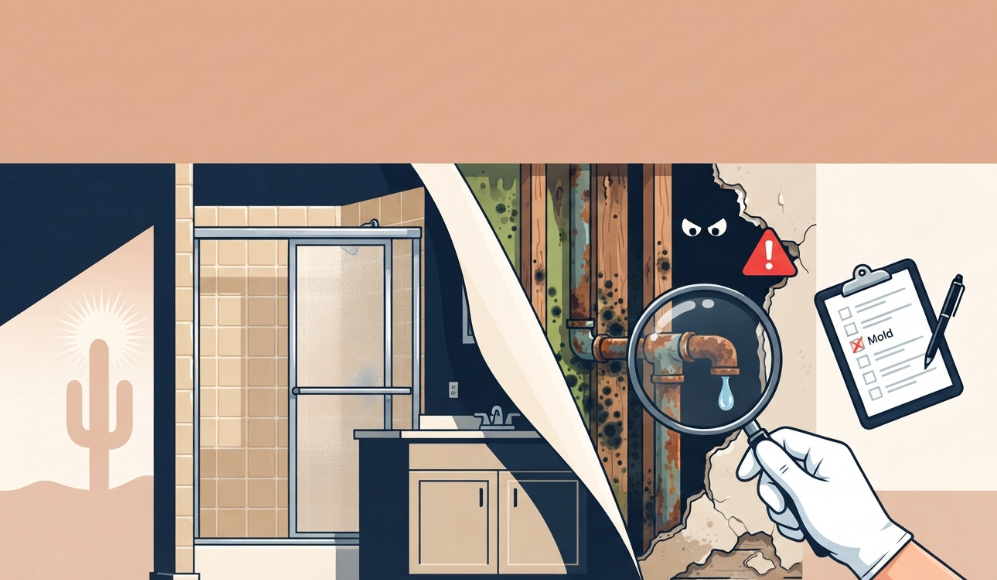
What We Actually Find When We Open Up a 20-Year-Old Gilbert Bathroom
Most of what we find once demolition starts on an older Gilbert bathroom isn’t a surprise to us, even when it is to the homeowner. A significant share of Gilbert’s housing stock is now 20 to 25 years old, with pockets of the town considerably older, and bathrooms that age have had two decades of hard water, daily moisture, and original construction quietly working against them behind the walls. Below is an honest account of what actually turns up once tile and drywall come out — not to alarm you, but because knowing this ahead of time is exactly what separates a remodel that goes smoothly from one that feels like a series of unpleasant surprises.
Why Being Honest About This Matters
The single biggest fear we hear from Gilbert homeowners, and the theme that comes up constantly in local online discussions about remodeling, isn’t the cost of the project itself — it’s the fear of a contractor using “we found something extra” as an excuse to inflate the price mid-project. We understand why that fear exists. Our answer to it is straightforward: we tell you plainly what’s genuinely common to find in a home of your bathroom’s age before you sign anything, so nothing that turns up should feel like it came out of nowhere. Read our quick guide on how to avoid a bad contractor and Change Order Explained in Gilbert, AZ?
What We Commonly Find Behind the Shower
A Degraded Waterproofing Membrane
The waterproofing layer behind shower tile isn’t visible once tile is installed, and in a lot of 20-plus-year-old Gilbert bathrooms, it was either installed to a lower standard than we’d use today or has simply broken down over two decades of constant moisture exposure. This is one of the most common findings, and it’s the reason a shower that “looks fine” on the surface can still have real water damage building behind it.
A Cracked or Failing Shower Pan
The pan beneath the shower floor is supposed to be completely watertight. After 20-plus years, it’s genuinely common to find hairline cracks or a pan that’s lost its seal at the drain, both of which allow water to seep into the subfloor slowly, often for years, before it becomes visible as a stain or a soft spot.
Water Damage in the Subfloor or Framing
Once a waterproofing failure has been active for a while, it’s common to find water-damaged subfloor material or, less often, framing that needs repair. We treat this as a normal, expected part of remodeling a home this age — not a reason to be alarmed, but a genuine reason it needs to be addressed properly rather than tiled over.
What We Commonly Find With Plumbing
Mineral Scale Buildup Inside Pipes and Valves
Gilbert’s water averages 8 to 10 grains per gallon according to the Town of Gilbert’s own published data, and two decades of that mineral content passing through original supply lines and shower valves often leaves visible scale buildup that’s been quietly restricting water flow long before anyone noticed. Full detail on our Gilbert’s Hard Water and Your Bathroom Remodel page.
Outdated Pipe Materials in Genuinely Older Homes
In Gilbert homes from the 1980s and early-to-mid 1990s specifically — more common in the town’s oldest communities than in its 2000s-era construction wave — original plumbing sometimes includes polybutylene pipe, a plastic plumbing material installed nationwide between 1978 and 1995 that was the subject of a major class-action settlement Cox v. Shell Oil Co. after widespread reports of the material becoming brittle and failing from the inside. If your home falls in that age range, we flag this directly during the in-home evaluation, since it’s a genuine, well-documented issue worth addressing proactively rather than waiting for a failure.
Corroded or Undersized Supply Lines
Original supply lines, especially in older construction, sometimes show corrosion or were sized to older code standards that no longer match modern fixture demands, which we address as part of a full remodel rather than leaving in place behind new tile.
What We Commonly Find With Electrical
No GFCI Protection
Ground-fault circuit interrupter outlets, now a code requirement in bathrooms, weren’t always standard in older construction. It’s common to find original bathroom outlets without this protection in homes built before it became a consistent requirement, and we update this as part of any remodel that touches electrical.
Undersized or Aging Wiring for Modern Fixtures
Original electrical sometimes wasn’t sized for the lighting and ventilation loads a modern bathroom remodel typically adds, which we account for during the design and permitting phase rather than discovering it as an unplanned surprise mid-project.
What We Commonly Find With Original Materials
Deteriorated Cultured Marble
Cultured marble vanity tops and tub surrounds were a common builder-grade choice in Gilbert homes from the 2000s construction wave. The material is genuinely porous, and after two decades of Gilbert’s hard water, it’s common to find it etched, stained, or cracked at stress points — a problem a new quartz surface resolves permanently.
Cracked Grout Allowing Water Behind Tile
Grout naturally deteriorates over time, and once it’s compromised, water can work its way behind tile even if the tile itself looks intact. This is frequently the actual root cause behind a waterproofing failure we find during demolition.
A Note on Genuinely Old Homes
In homes built before the early 1980s — a smaller share of Gilbert’s housing stock, concentrated mainly in the older sections near the Heritage District — certain original materials like vinyl floor tile or textured ceiling finishes can, in some cases, contain asbestos. We don’t test or handle this ourselves; if a home’s age and materials suggest it’s a possibility, we recommend professional testing before any demolition proceeds, and we pause work in that area until results are confirmed. This is a rare finding overall, but it’s worth knowing about honestly rather than glossing over for homes old enough that it’s a realistic possibility.
How We Handle It When Something Is Found
We Show You, Not Just Tell You
When we find something during demolition, we show you directly, whenever possible, rather than describing it over the phone. Seeing the actual condition makes the explanation and the recommended fix much clearer.
We Explain the Real Options
For most findings, there’s a range of ways to address it, from a minimum fix to a more thorough repair. We walk through the tradeoffs honestly, including cost and long-term implications of each option, rather than defaulting to whichever is most profitable for us.
We Price It Before Continuing
Any additional work gets priced and agreed to before we proceed, as a documented change to your original proposal — never assumed, never added to a final invoice as a surprise.
We Build a Contingency Into Planning From the Start
For homes in the age range where hidden issues are genuinely common, we discuss a realistic contingency amount during your consultation, so the possibility is part of your budget conversation from day one, not something introduced only after demolition has already started.
This Is Also Exactly Why We Don’t Recommend Skipping the Right Process
A liner installed directly over an existing shower, or a bathroom remodel that skips real waterproofing to save time, doesn’t fix any of what’s described above — it just covers it up. Given how common these findings genuinely are in Gilbert’s older housing stock, that’s a real reason to choose a full remodel process over a shortcut, not just a sales point. See our full Bathroom Remodel Cost Guide for how a properly built remodel is priced, and our Permits & HOA Guide for when work like this requires a Town of Gilbert permit.
Frequently Asked Questions About What’s Behind an Older Gilbert Bathroom Wall
Is it normal to find problems once demolition starts on an older bathroom?
Yes, genuinely common, especially in bathrooms 20 years or older. Waterproofing degradation, mineral scale in plumbing, and worn original materials are all frequent findings in Gilbert’s aging housing stock.
Will finding a problem always mean a much bigger bill?
Not necessarily. Many findings are addressed as a reasonable, clearly explained addition to the project, with the cost and options discussed before any work proceeds, not sprung on you as a final invoice surprise.
What is polybutylene pipe, and should I be worried about it?
Polybutylene is a plastic plumbing material installed in millions of U.S. homes between 1978 and 1995 that became the subject of a major class-action settlement after widespread failures. It’s more relevant to Gilbert’s older communities than its 2000s-era construction, and we flag it directly if your home’s age makes it a possibility.
How do you handle a contingency budget for hidden issues?
We discuss a realistic contingency percentage during your consultation, based on your home’s age and construction era, so it’s part of your budget planning from the start rather than an unexpected addition later.
Could my bathroom have asbestos-containing materials?
It’s uncommon and mainly a consideration in homes built before the early 1980s. We don’t test or handle it ourselves — if your home’s age suggests it’s a possibility, we recommend professional testing before demolition and pause work until results are confirmed.
Does Gilbert’s hard water actually cause these kinds of problems?
Yes, directly in some cases — mineral scale buildup in pipes and valves, and accelerated deterioration of porous materials like cultured marble, are both tied to Gilbert’s water hardness. Full detail on our Gilbert’s Hard Water and Your Bathroom Remodel page.
Ready for an Honest Look at Your Bathroom?
Call Ironwood Bath & Remodel at (480) 696-6664 or Contact us for a free in-home consultation. We’ll give you a realistic picture of what to expect for your home’s specific age, before you commit to anything. 2174 E Williams Field Rd, Gilbert, AZ 85295. Serving Gilbert, Chandler, Mesa, Queen Creek & Tempe · Open Monday–Sunday, 9am-8pm



4 Comments