
How to Avoid a Bad Contractor Experience in Gilbert, AZ
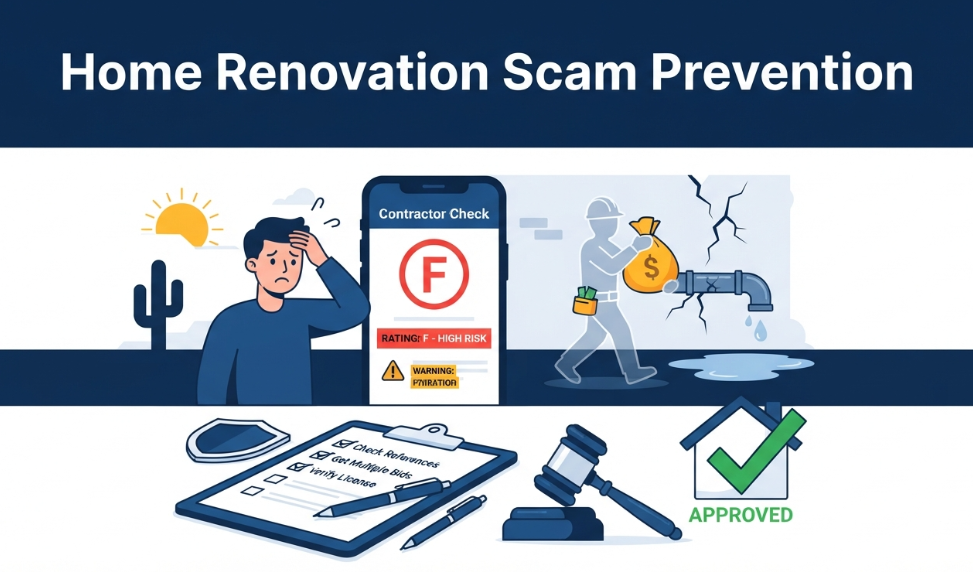
The single biggest fear homeowners have before starting a bathroom remodel isn’t the cost or the design decisions — it’s the possibility of hiring the wrong contractor. Change orders that balloon the price, a crew that disappears mid-project, work that fails inspection or leaks within a year: these aren’t rare horror stories, they’re common enough that the Federal Trade Commission maintains dedicated consumer guidance specifically about home improvement scams and disputes. Below is exactly what to check before you sign anything, the red flags that matter most, and the specific questions worth asking any contractor bidding on your Gilbert bathroom remodel — written by a company that would rather lose your business to a genuinely better fit than win it by hoping you don’t ask these questions.
Why This Fear Is So Common — and So Justified
Home improvement is one of the few major purchases where you’re paying for a promise before the work is fully visible, on a project happening inside your own home, often by people you’ve never worked with before. According to the Federal Trade Commission, common home improvement scams involve contractors who take a large upfront payment and then do shoddy work, disappear entirely, or pressure homeowners into decisions before they’re ready. None of this is unique to Gilbert, but it’s exactly why doing this legwork before signing a contract matters more than almost any other decision in the entire remodeling process. Read what we find when open a 20-year old bathroom, how to budget a bathroom remodel and Change Order Explained in Gilbert, AZ.
Verify the License Before Anything Else
Check the Arizona Registrar of Contractors
Any contractor performing work above a minimal dollar threshold in Arizona is legally required to hold a license through the Arizona Registrar of Contractors (ROC). You can look up any contractor’s license status, classification, and complaint history directly at azroc.gov, in under a minute, before ever agreeing to a bid. A legitimate contractor should give you their ROC number without hesitation — Ironwood’s is listed on every page of our site, AZ, and you’re welcome to verify it independently at any time.
Check for Bonding and Insurance
Beyond the license itself, confirm the contractor carries active bonding and general liability insurance. If something goes wrong on your property during a remodel — a work-related injury, accidental damage — this is what protects you from being financially exposed for someone else’s mistake.
Red Flags the FTC Specifically Warns Homeowners About
Pressure to Decide Immediately
Scammers commonly use “special deal, but only if you sign today” tactics specifically to prevent you from comparing bids or checking references. A legitimate contractor has no reason to rush a decision this significant.
Demanding Full Payment Up Front
The FTC specifically flags full up-front payment as a major warning sign. A reasonable deposit before work begins is normal; being asked to pay the entire project cost before any work happens is not.
Cash-Only Payment Requests
Cash leaves no paper trail, which makes it considerably easier for a bad actor to walk away without consequence. Paying by check or card, which the FTC specifically recommends, gives you a real dispute path if something goes wrong.
No Local Address or Only a Cell Phone Number
A legitimate, established local contractor has a verifiable business presence, not just a phone number that could belong to anyone.
Reluctance to Provide a Written Contract or References
A contractor who avoids putting scope, prices, and timelines in writing is either disorganized or deliberately leaving room to change the terms later. Similarly, a legitimate contractor with real completed work has no reason to withhold past client references. Read our detailed guide on Bathroom Remodel Timeline in Gilbert, AZ.
Suggesting You Pull Your Own Permit
This is one of the clearest red flags specifically flagged by the FTC: a legitimate contractor pulls the permit for work that requires one, as part of the job. A contractor asking you to obtain the permit yourself is often trying to avoid the accountability and inspection process a permit creates. See our full Permits & HOA Guide for when a Gilbert bathroom remodel actually requires one.
Door-to-Door Solicitation, Especially After Extreme Weather
Contractors who show up unsolicited, particularly after a storm, are a recognized pattern the FTC specifically warns about — sometimes called “storm chasers.” A contractor’s sudden appearance at your door isn’t inherently disqualifying, but it’s a reason to slow down and verify everything else on this list before signing anything.
Questions Worth Asking Before You Sign
Can I see your ROC license number, and can I verify it myself?
Any contractor should answer this instantly and without hesitation.
Will you pull the permit, and what does that cost?
A legitimate contractor factors this into their proposal as a standard line item, not an afterthought.
What’s your payment schedule, and what triggers the final payment?
You want to understand exactly what percentage is due when, and confirm the final payment isn’t due until you’re genuinely satisfied with the completed work.
Can I see photos or visit a recent project you completed nearby?
A contractor with real, recent local work should be able to show you something concrete, not just a portfolio of stock photography.
What happens if you find something unexpected once demolition starts?
This is one of the most revealing questions you can ask. A contractor who has a clear, honest answer — how they’ll communicate it, how pricing changes get handled — is thinking like a professional who’s actually done this before. A contractor who brushes off the question is more likely to surprise you with it later.
What’s your warranty, and is it in writing?
A verbal promise of a warranty means nothing if a dispute ever arises. Ask for the specific terms in writing before you sign.
What a Trustworthy Bathroom Remodeling Process Actually Looks Like
Here’s what the opposite of a bad experience looks like, and what we build every Gilbert project around:
- A licensed, verifiable ROC number displayed openly, not something you have to ask for
- A written, itemized, fixed-price proposal before any demolition begins
- The contractor pulling and managing the permit as a standard part of the job, not an optional add-on
- Real material selections chosen with you, not vague “allowances” that turn into upcharges later
- Honest communication if something unexpected is found once a wall is opened
- A written warranty with actual terms, not a verbal promise
If a bid you’re comparing against ours doesn’t include all of these, that’s worth asking about directly — a lower number that’s missing several of these isn’t actually the same offer.
Why This Matters More for a Bathroom Remodel Specifically
A bathroom remodel touches plumbing, electrical, and waterproofing — the exact systems where cut corners cause the most expensive, hardest-to-detect problems. A leak behind a poorly waterproofed shower wall, or electrical work that fails inspection, doesn’t always show up immediately; it shows up months or years later, often as a much larger repair than the original remodel would have cost done correctly. This is precisely why verifying licensing, insurance, and process matters more here than it might for a lower-stakes home project.
Frequently Asked Questions About Choosing a Bathroom Remodeling Contractor in Gilbert
How do I verify a contractor’s license in Arizona?
Search the contractor’s name or license number directly at azroc.gov, the Arizona Registrar of Contractors’ official site, which shows license status, classification, and any complaint history.
Is it normal to pay a deposit before work begins?
Yes, a reasonable deposit is standard practice. What’s not normal, and what the FTC specifically warns against, is being asked to pay the full project cost before any work has started.
Should I be worried if a contractor shows up at my door offering to do work?
Not automatically, but the FTC specifically flags unsolicited door-to-door contractor solicitation as a recognized scam pattern, so it’s worth verifying everything else on this list carefully before signing anything with someone who approached you first.
What should I do if I think I’ve been scammed by a contractor?
The FTC recommends contacting your state attorney general’s office or local consumer protection office, and reporting the incident directly at reportfraud.ftc.gov.
Does Ironwood Bath & Remodel pull permits for its projects?
Yes. Pulling and managing any required Town of Gilbert permit is a standard part of every applicable Ironwood project, not an optional add-on. See our full Permits & HOA Guide.
What’s the biggest single red flag when hiring a remodeling contractor?
Being pressured to pay in full up front or to sign a contract immediately without time to think it over are two of the clearest warning signs specifically identified by the FTC.
Ready to Talk to a Contractor You Can Actually Verify?
Call Ironwood Bath & Remodel at (480) 696-6664 or Contact us for a free consultation. Check our license at azroc.gov before you even call, read real reviews on our Testimonials page, and see our completed work on our Portfolio page — we’d rather you verify everything than take our word for it. 2174 E Williams Field Rd, Gilbert, AZ 85295. Serving Gilbert, Chandler, Mesa, Queen Creek & Tempe · Open Monday–Sunday, 9am-8pm


2 Comments